


Data Integration is the BuildOT One connectivity layer for BMS IoT integration. It connects the platform to the systems you already run over BACnet, Modbus, MQTT, LoRaWAN and API-based links, so wireless sensor data can sit beside existing BMS and meter data without replacing anything.


| Key fact | Detail |
|---|---|
| Module | Data Integration (connectivity and integration layer) |
| Part of | BuildOT One |
| What it does | Brings device, meter and system data into one cloud platform and shares it onward |
| Data sources | LoRaWAN EU868 sensors, NRF devices, meters, existing BMS, third-party systems |
| Integrations | BACnet, Modbus, MQTT, LoRaWAN, APIs, CAFM, ERP, billing systems |
| Typical users | BMS engineers, IT teams, system integrators, facility managers |
What data integration does
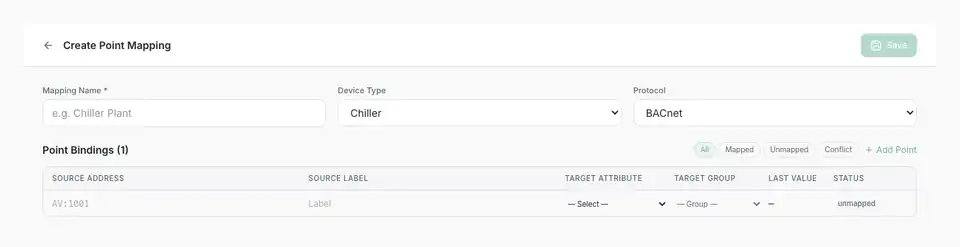
- Speaks building protocols. BACnet, Modbus, MQTT and LoRaWAN are supported, along with API-based integration.
- Works with legacy systems. It connects to existing BMS, meters and infrastructure without replacement.
- Shares data onward. Air quality data can reach a campus BMS over BACnet. At HCT, 10-parameter IAQ sensors across 11 campuses and 59 buildings do this.
- Links business systems. It integrates with CAFM, ERP, billing and third-party platforms.
- Normalises data. Readings from many sources are mapped to one common data model.
- Manages devices. Devices and gateways are registered, configured and tracked in the asset registry.
BMS IoT integration features
- Cloud-native data ingestion
- Device and gateway management
- Site, building, floor, asset and device hierarchy
- Bulk import and export for onboarding
- Webhook and API links to workflow automation tools
- Role-based access control and multi-tenant separation
- Secure data exchange with authentication and secure communication
- REST API access for enterprise applications
- LoRaWAN EU868 wireless coverage through MachineSens gateways
How it works
- Connect devices. Sensors, meters and building systems send data over standard protocols.
- Collect at the edge. Gateways gather device data and pass it on securely.
- Process. Incoming streams are merged into one operational dataset.
- Share. Enterprise and operational applications read building data through APIs and messaging.
Can you retrofit an existing building without rewiring?
Yes. To retrofit an existing building without rewiring, BuildOT One brings LoRaWAN (EU868) and NRF wireless devices into your current BMS over BACnet, Modbus or MQTT, and a typical building goes live in about 30 days. At a beachfront hotel in Ajman, wireless meters cost about 30% less than an RS485 retrofit.
Who uses it
BMS engineers and integrators use it to add wireless points to existing systems. IT teams use it to connect BuildOT One with enterprise software. A typical building goes live in about 30 days.
Works with
- AirBMS for equipment data
- Automation Hub for workflows
- FM360 for CAFM links
- Gateways and indoor air quality sensors
- Related solution page: building performance management
Frequently asked questions
Can BuildOT One both read from and write to my BMS?
It reads from existing BMS over BACnet and Modbus, and can also share wireless sensor data back to the BMS, as it does for the HCT campuses.
Which protocols are supported?
BACnet, Modbus, MQTT, LoRaWAN and API-based integrations.
Can it connect to our CAFM or ERP?
Yes. External system connectivity covers CAFM, ERP and billing systems.
Explore all BuildOT One modules
Planning an integration? Request a demo
